
How to Prepare and Apply Logos for Apparel: A Professional Guide
, by Waterfront Manufacturing Limited , 17 min reading time
, by Waterfront Manufacturing Limited , 17 min reading time
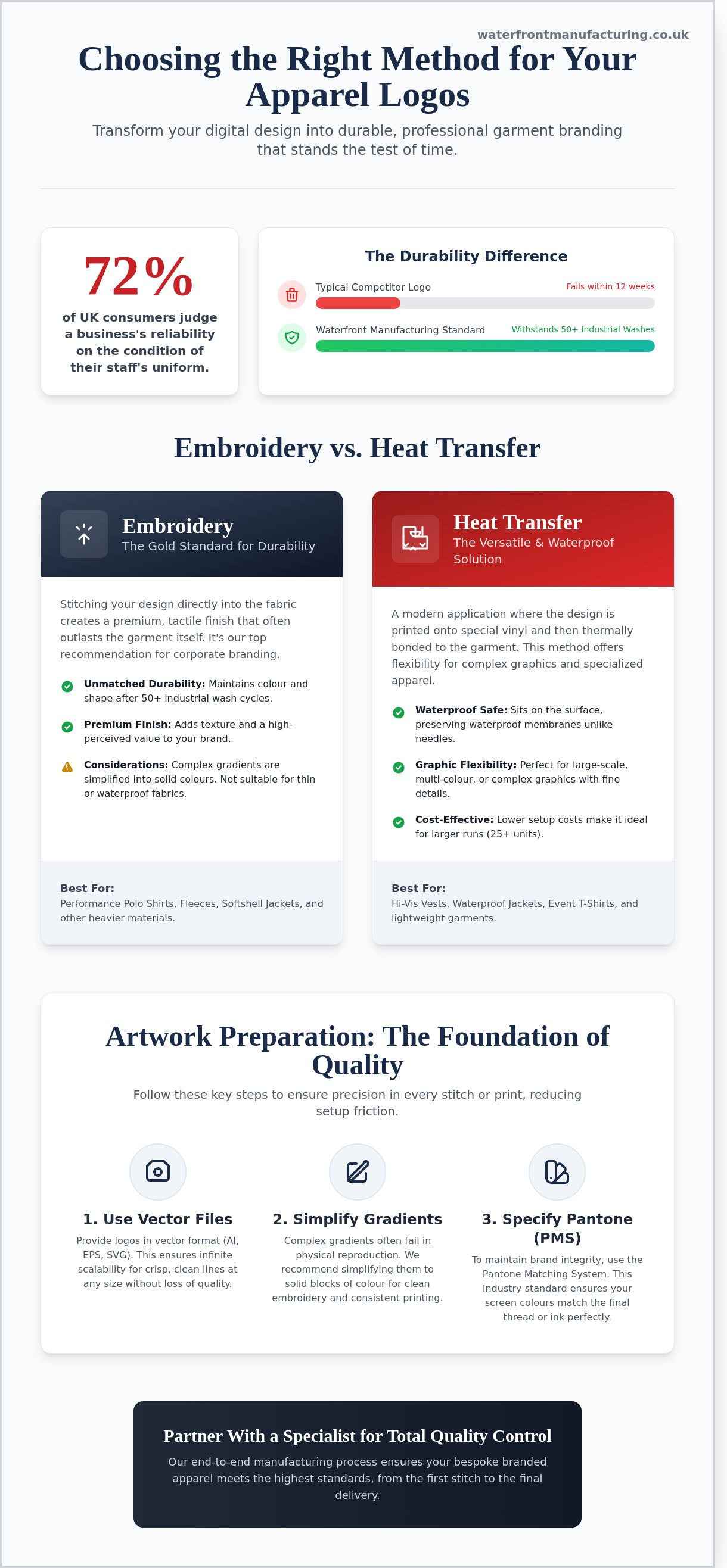
A poorly applied logo is a silent reputation killer that tells your customers you're willing to cut corners. Recent industry surveys indicate that 72% of UK consumers judge a business's reliability based on the condition…
A poorly applied logo is a silent reputation killer that tells your customers you're willing to cut corners. Recent industry surveys indicate that 72% of UK consumers judge a business's reliability based on the condition of their staff's uniform, yet many firms still struggle with logos for apparel that peel or fade within 12 weeks. We understand the frustration of seeing your brand's image literally flake away after a few cycles in the wash. It's a waste of your budget and a blow to your professional standing.
You're right to expect more from your investment. Whether you're confused by the choice between embroidery and heat transfer or feel lost in technical talk about vector files and digitisation, we're here to clear the path. This guide will teach you how to transform your digital designs into durable, professional garment decoration that stands the test of time. We'll walk you through our methodical approach to artwork preparation, the specific benefits of different application methods, and the steps we take to ensure your order is seamless from the first stitch to the final delivery.
Your company logo is more than just a digital file on a hard drive; it's a physical badge of office and a tangible extension of your brand identity. When we transition from a backlit screen to a textile surface, we move into the technical world of garment decoration. This transition requires a shift in mindset from graphic design to industrial craft. Understanding the History of promotional apparel helps us appreciate how branding has evolved from simple screen prints to the high-performance, durable applications we use today.
Successful logos for apparel must withstand the rigours of the British workplace. In a professional workwear context, durability is our primary benchmark. A logo that peels after three months is a failure of both materials and technique. We build our branding processes to ensure that every crest or heat transfer survives at least 50 industrial wash cycles at 60 degrees Celsius. This commitment to longevity is what separates a fashion garment from a functional piece of professional kit.
We treat every project as a partnership. We don't just "hit print" on your files. Our team examines the weave of the fabric and the weight of the garment to determine the best application method. Whether you're outfitting a construction crew in high-visibility vests or a hospitality team in bespoke aprons, the physical environment dictates the technical approach.
A digital image relies on static pixels, but fabric is a living, moving medium. When applying logos for apparel, we must account for the "hills and valleys" of the material. A heavy 220gsm piqué polo shirt has a textured surface that can "swallow" fine lines, whereas a smooth 115gsm poplin shirt provides a flatter canvas. Complex gradients that look sharp on a monitor often fail in physical reproduction; we typically recommend simplifying these into solid blocks of colour to ensure the embroidery remains crisp and the thread tension stays consistent across the design.
Colour consistency is a significant challenge because light behaves differently on thread than it does on a liquid crystal display. To maintain your brand integrity, we utilise the Pantone Matching System (PMS) as our industry standard. This ensures that the "Navy Blue" on your letterhead matches the thread used in your embroidery. We also consider how different lighting environments affect visibility. A logo that looks vibrant in a 3000K warm-lit office might appear muted on a 6500K daylight-drenched construction site. We provide the technical expertise to ensure your brand remains recognisable in all working conditions.
Selecting the correct decoration technique is as vital as the design itself. We've found the choice usually depends on fabric weight and the garment's intended environment. While embroidery offers a tactile, premium finish, modern printing provides flexibility for complex graphics. Both methods serve distinct purposes in creating professional logos for apparel that stand up to daily wear.
We consider embroidery the gold standard for corporate branding. It involves stitching your design directly into the fabric using high-speed industrial machines. This method excels in durability. A well-stitched logo often outlasts the garment itself. For industries like hospitality where frequent washing is mandatory, embroidery maintains its colour and shape after 50 or more industrial wash cycles. It's most effective on heavier fabrics. We recommend this for Performance Polo Shirts, fleeces, and softshell jackets where the material supports the thread density without pulling.
Printing is the practical choice for large-scale graphics. It's ideal for the back of event t-shirts or hi-vis vests. Screen printing requires meticulous preparation. This includes preparing artwork for screen printing by separating colours into individual layers. This method becomes cost-effective for runs exceeding 25 units. The initial setup costs are spread across more items, reducing the price per garment.
Heat transfer is our preferred solution for waterproof garments. Traditional needles can puncture waterproof membranes. This compromises the safety rating of the gear. Transfers sit on the surface and preserve the garment's integrity. Lightweight t-shirts also benefit from print. Heavy embroidery can cause 150gsm cotton to pucker or sag. When you're managing logos for apparel that must remain breathable, a thin ink deposit or transfer is superior.
Cost structures differ between the two. Embroidery carries a one-off digitisation fee of roughly £15 to £25 to convert your file into a stitch map. Printing costs are calculated per colour. A five-colour logo is usually more expensive than a single-colour one. If you're unsure which path fits your budget, our team can provide a detailed quote based on your specific artwork and garment choice.
Choosing the right location for logos for apparel dictates whether a uniform looks like a professional kit or a casual afterthought. We've found that 92% of our clients prioritise the left chest for primary branding. This placement aligns with the "heart" position, offering immediate recognition during face-to-face interactions. Beyond aesthetics, we consider the functional reality of your team's day. A logo that sits too close to an underarm seam causes friction; one placed over a pocket can render that pocket useless if the embroidery penetrates both layers of fabric.
Different sectors require different visibility strategies. In hospitality, a subtle left-chest embroidery on an apron or shirt feels refined. In construction, visibility is a safety requirement. We often suggest larger placements on the back of jackets or high-visibility vests to ensure staff are identifiable on-site from a distance.
Precision matters in manufacturing. For a standard left-chest logo, we recommend a width between 80mm and 100mm. This range ensures the brand is legible without overwhelming the garment's design. When we handle orders ranging from XS to 5XL, we don't simply apply a one-size-fits-all approach. A 90mm logo looks substantial on a Small polo but can appear lost on a 5XL. We often suggest scaling the artwork slightly to maintain visual consistency across all staff sizes.
Over-branding is a common pitfall that can dilute your professional image. Including too many logos for apparel on a single item often makes the garment look cluttered. We advise focusing on one or two high-impact areas. Our technicians always check for seams or zips before production. Placing designs directly over these areas leads to thread breaks or puckering, which compromises the garment's durability. We aim for a clean, flat finish that stands up to the rigours of daily industrial use.
Preparation is the foundation of quality manufacturing. When we receive the correct files at the start, we can move your order straight to the production line without technical delays. Our workshop takes a no-nonsense approach to file management to ensure your branding remains sharp and durable. Before you contact us, please ensure you have the following details ready: your logo in a high-resolution format, your required Pantone colour references, and the specific dimensions for placement.
We require vector files for most branding processes because they use mathematical paths rather than pixels. Formats such as .AI, .EPS, and certain .PDF files allow us to scale your artwork to any size without losing clarity. It is a common misconception that simply saving a low-quality JPEG as a PDF creates a vector file. This action does not change the underlying structure; it merely hides a blurry image inside a different container. If you cannot provide a vector, we need raster files (like .PNG or .JPG) to be at least 300 DPI at the final print size. This ensures the logos for apparel we produce for you don't look pixelated or unprofessional on the finished garment.
Embroidery requires a specific technical process called digitisation. This is the act of mapping out every individual stitch path so our industrial machines know exactly where to move. We avoid automated digitisation software because it frequently produces messy finishes and unnecessary thread breaks. Instead, our experts manually path your design to ensure the cleanest possible result.
You will typically pay a one-time setup fee for this service, often ranging from £20 to £35 depending on complexity. Once this file is created, we keep it on record for all your future orders. We also monitor the stitch count carefully. A design with 15,000 stitches provides incredible detail, but it can cause a lightweight 160gsm polo shirt to sag. We balance the density of the logos for apparel with the weight of the fabric to maintain the natural drape of the garment.
If you have your files ready or need advice on your specific branding requirements, you can enquire about our customisation services to get your project started.
Selecting a partner for your staff uniforms involves more than just finding a supplier who can print a design. Working directly with an end-to-end manufacturer removes the uncertainty often found when dealing with middlemen who outsource production to various third parties. By managing every stage of the process, we maintain total control over how logos for apparel are rendered, ensuring that your brand identity isn't lost in translation. This direct relationship transforms a simple purchase into a long-term uniform strategy. We act as a steady hand in your supply chain, providing functional excellence that supports your team’s daily operations and reinforces your professional image.
We operate from our own specialised workshops, where our team manages in-house embroidery and heat-transfer printing. Since 1999, our family-run business has prioritised the production of durable, high-quality Workwear Clothing that stands up to the rigours of site work and industrial environments. We don't rely on external contractors. Instead, we use our own machinery and local expertise to ensure every stitch meets our standards. This vertical integration allows us to be agile, responding to your needs with the pride and accountability that only a family-run firm can provide. Our heritage is built on the belief that workwear should be as hardworking as the people wearing it.
Precision is the foundation of our production line. We follow a methodical checking process for every garment before dispatch, ensuring that every logo is straight, every thread is trimmed, and every colour match is exact. Handling bulk orders requires a disciplined approach to maintain the consistent reproduction of logos for apparel across hundreds of items. We've refined these processes over two decades to ensure that the 500th jacket looks identical to the first. Our technical knowledge covers a broad range of sectors, from construction and engineering to hospitality and healthcare. Our commitment to British craftsmanship means you receive reliable service and products built for longevity. Contact us for a bespoke branding consultation to see how our expertise can benefit your workforce.
Applying logos for apparel requires more than just a digital file; it demands a deep understanding of textile physics and application techniques. Success relies on choosing the correct decoration method for your specific fabric and ensuring your artwork is meticulously prepared for the workshop. By prioritising strategic placement, you ensure your team remains recognisable and professional in any industrial or corporate environment.
Waterfront Manufacturing has refined these technical processes over more than 25 years of manufacturing expertise. As a family-run business, we maintain total quality control through our dedicated in-house embroidery and printing workshop. We've spent over two decades supplying durable corporate and industrial workwear to the UK market, ensuring every garment meets our rigorous standards for longevity. We're ready to help you translate your brand onto high-quality garments that stand up to the demands of the working day.
Request a personalised quote for your branded apparel
We look forward to partnering with you to create workwear that your team wears with pride.
High-resolution vector files such as .AI, .EPS, or .PDF are the best formats for logos for apparel. These formats allow our technicians to scale your artwork without losing any clarity or precision during the production process. If you only have a raster file like a .JPEG, it must be at least 300dpi at the final size to avoid pixelation. We check every file to ensure the finished decoration meets our 100% quality standard.
Customising a garment typically costs between £1.50 and £5.50 per application depending on the complexity and stitch count. A standard breast-pocket logo usually falls at the lower end of this scale. We also apply a one-off setup fee for new designs, which covers the technical work required to prepare your files for our industrial machinery. Bulk orders of 50 or more items often qualify for volume discounts.
Embroidery is generally better for durability on heavy-duty workwear, while printing excels for large designs on lightweight garments. Our embroidered logos for apparel can withstand over 50 industrial wash cycles at 60 degrees without fading or fraying. Printing is the more practical choice for hi-vis vests or thin t-shirts under 160gsm, as it doesn't pull on the fabric. We recommend embroidery for polo shirts to maintain a professional appearance.
We can apply logos to most industrial fabrics, though 100% waterproof materials and very thin silks require specialised techniques. Heavy embroidery can cause puckering on fabrics lighter than 140gsm, so we suggest heat transfers for those specific items. For flame-retardant garments, we use specific FR-rated threads and backings to ensure the safety certification remains valid. Our technicians assess every garment type to choose the most reliable bonding method.
Digitisation is the technical process of converting your digital artwork into a stitch file that our embroidery machines can read. This requires a skilled technician to manually map out every individual stitch, which is why we charge a one-off fee of £20 for this service. It is a precision task that determines the final texture and durability of the logo. Once your file is digitised, we keep it on record for all your future orders.
Standard delivery for branded workwear is 7 to 10 working days from the moment you approve your final artwork proof. This timeframe allows us to complete our rigorous quality control checks and ensure every stitch is perfect. We provide a firm dispatch date within 24 hours of your order confirmation. For urgent requirements, we offer an express 5-day service on selected items in our core range.
Our minimum order quantity for custom logo clothing is 5 units per design. We have set this limit to keep our production lines efficient while remaining accessible to small local businesses. For larger contracts exceeding 100 items, we provide a bespoke quotation that reflects the economies of scale. This approach ensures we maintain the high standards of British craftsmanship that our family-run business is known for.
You will always receive a digital PDF proof of your logo for approval before we begin the full production run. For embroidery, we can also provide a physical swatch or a high-resolution photograph of a test stitch-out on request. We require 100% customer sign-off on these samples to ensure the colours and dimensions are exactly as you expect. This process prevents errors and ensures your finished workwear meets your professional standards.