

The Professional Guide to Workwear Clothing: Quality, Durability, and Branding in 2026
, by Waterfront Manufacturing Limited , 17 min reading time
, by Waterfront Manufacturing Limited , 17 min reading time
Did you know that as of 2025, OSHA mandates that all personal protective equipment must properly fit each individual worker, effectively ending the era of "one-size-fits-most" in the construction sector? This shift refle…
Did you know that as of 2025, OSHA mandates that all personal protective equipment must properly fit each individual worker, effectively ending the era of "one-size-fits-most" in the construction sector? This shift reflects a broader truth for 2026; high-quality workwear clothing is no longer just a uniform, it's a precision tool that impacts safety, morale, and your bottom line. We understand the frustration of watching a bulk order of garments lose their shape after just three washes or seeing your logo appear inconsistent across different fabrics. It's a waste of your budget and a blow to your team's professional image.
We're here to help you master the art of selecting professional workwear that balances textile longevity with precision branding for your national workforce. In this guide, we'll examine the technical differences between embroidery and heat transfer, the latest 2026 safety standards, and how a dependable supply partner provides a high ROI through garment durability. You'll learn how to build a unified team appearance that stands up to the rigors of industrial laundering while maintaining a sharp, professional edge. We believe in a no-nonsense approach to manufacturing where quality and reliability come first.
Standards for professional attire have shifted significantly as we enter 2026. Selecting the right workwear clothing involves more than just picking a corporate color; it requires an understanding of textile engineering and long-term functional performance. We've seen a clear move toward performance workwear that refuses to compromise. Modern teams expect garments that offer the breathability of athletic gear while maintaining the extreme durability required for industrial environments. To understand why these standards exist, one can look at the History of workwear, which shows a clear evolution from basic protection to highly specialized technical apparel that supports a worker's daily tasks.
A unified team appearance does more than just identify a staff member. It serves as a mobile billboard for your service standards, projecting a message of reliability to every client your team meets. We find that consistent branding across a national workforce fosters a deep sense of team cohesion. When an employee puts on a high-quality 3-layer softshell jacket or a crisp Oxford shirt, there's a psychological shift toward professional accountability. This collective identity is a critical component of corporate safety too; it ensures that authorized personnel are easily recognizable in high-hazard zones or public-facing roles.
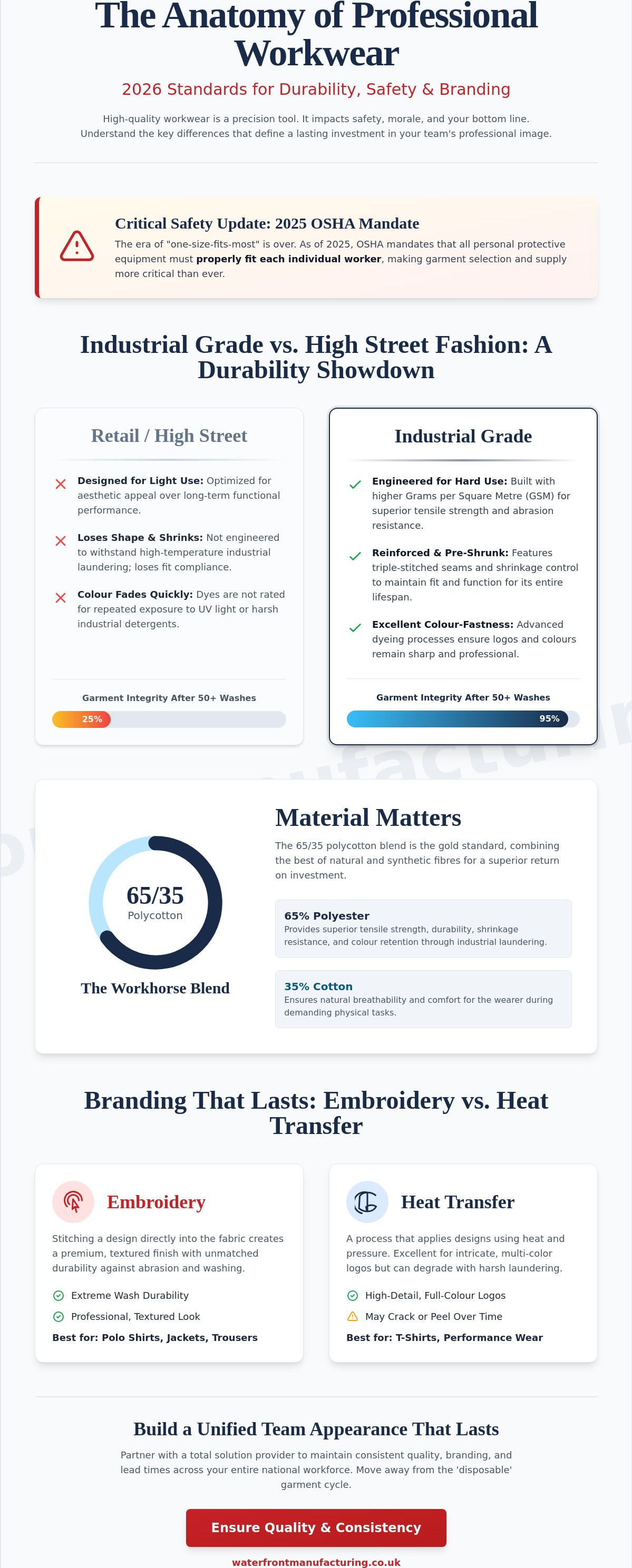
The distinction between high-street fashion and industrial-grade garments is often invisible at first glance. However, the difference becomes stark after the first ten industrial wash cycles. Retail clothing is designed for light use and aesthetic appeal. In contrast, industrial-grade workwear clothing is built with a higher Grams per Square Metre (GSM) count. This fabric weight directly impacts the garment's tensile strength and its ability to resist abrasion in tough trade environments. While a retail polo might lose its shape or pill quickly, an industrial performance polo shirt is engineered to withstand the rigors of daily wear and high-temperature laundering without degrading.
When we evaluate a garment's quality, we look for specific technical indicators that guarantee a high return on investment:
By focusing on these industrial standards, we help you move away from the "disposable" garment cycle. True professional workwear is an investment in your team's comfort and your brand's enduring reputation.
This focus on quality and long-term value extends to all industrial supplies. For instance, Abbey Extrusions offers specialist plastic tubing and bespoke profiles that provide the same reliability and precision that businesses expect from their professional workwear.
Choosing the right textile is the foundation of any high-quality uniform. We believe that the fabric's composition dictates not only the comfort of the wearer but also the ultimate return on investment for the business. While aesthetic appeal matters, the technical specifications of workwear clothing must align with the daily physical demands of the job. For many industries, this selection process is guided by safety obligations, such as OSHA's general requirements for protective equipment, which emphasize the importance of providing garments that offer adequate protection against specific workplace hazards.
The 65/35 polycotton blend remains the gold standard for industrial durability. We favor this ratio because it combines the natural breathability of cotton with the superior tensile strength of polyester. This blend is particularly resistant to the mechanical stress of industrial laundering. It resists shrinking and maintains its shape over hundreds of cycles. You'll find this material used extensively in our cargo work trousers and performance polo shirts, where a balance of comfort and "easy-care" wrinkle resistance is essential for a professional appearance.
In corporate environments, the weave of the fabric is just as important as the fibre itself. When selecting office wearing clothes for women, the choice often falls between Poplin and Oxford. A poplin blouse offers a smooth, lightweight finish that looks sharp under a tailored jacket. Conversely, an Oxford shirt uses a heavier, basket-weave structure that provides more durability for long shifts. For those working outdoors, we provide 3-layer softshell jackets. These utilize a technical membrane that is windproof and water-repellent while remaining breathable, a significant upgrade over traditional heavy coats.
The industry is also seeing a shift toward sustainable materials. We've integrated organic cotton and recycled polyesters into our range, such as our organic cotton t-shirts and eco-conscious fleeces. These materials don't sacrifice performance; they often feature the same moisture-wicking and anti-static properties found in traditional synthetics. If you're looking for a steady hand to help you select the right materials for your team, we invite you to explore our full range of durable workwear solutions. We focus on the technical details so you can focus on your business.
Selecting the right workwear clothing is only half the battle. The method used to apply your logo determines whether that uniform remains a professional asset or becomes a liability after a few months of service. We treat garment decoration as a technical craft, not an automated afterthought. Every logo begins with a digitisation process. Our technicians convert your artwork into a specialized stitch file that controls the density, direction, and tension of the embroidery threads. This precision ensures that even complex corporate identities are rendered with absolute clarity across your entire workforce.
In 2026, the durability of branding is a primary concern for national companies. High-quality embroidery typically lasts the entire lifetime of the garment, often exceeding 200 industrial wash cycles. In contrast, while heat transfer technology has improved, it generally reaches its limit around 100 to 150 cycles before the edges may show signs of wear. While adhering to OSHA Personal Protective Equipment standards, we ensure that the branding process never compromises the structural integrity or safety ratings of the base materials. We manage every stage in our in-house workshop. This gives us total quality control and allows us to meet lead times that larger, purely automated competitors often miss.
Embroidery provides a three-dimensional, high-texture finish that conveys industrial authority. It's the preferred choice for our men's tailored jackets, v-neck cotton knitwear, and heavy-duty performance polo shirts. Because the thread is physically woven into the textile, it resists the mechanical abrasion common in construction and trade environments. Our family-run roots mean we take personal accountability for every stitch, ensuring your brand is represented with the same pride we take in our craftsmanship.
There are specific scenarios where heat transfer or screen printing is the superior technical choice. For promotional tote bags or large-scale event requirements, screen printing offers a cost-effective solution for bulk distribution. When dealing with performance fabrics, such as our 3-layer softshell jackets or waterproof storm-proof parkas, heat transfer is often necessary. This method allows us to apply intricate, multi-coloured logos without puncturing the fabric. It maintains the integrity of the waterproof membrane while providing a sharp, photographic finish. We use high-grade adhesives to ensure these transfers remain bonded even under significant environmental stress.
One of the most complex challenges for a national business is maintaining a unified brand identity across diverse departments. We often see companies where the office staff and site engineers look like they work for entirely different organisations. Our approach to workwear clothing is built on a comparison framework that ensures every employee, from the boardroom to the building site, feels part of the same team. We focus on a "head-to-toe" strategy, matching the technical specifications of trousers, tops, and outerwear to the specific physical demands of each role while keeping the visual branding consistent.
Modern professional attire has moved beyond the restrictive suits of the past. As leading corporate uniform suppliers uk, we provide smart-casual solutions that maintain a sharp, client-facing edge. For women, this often includes tailored trousers paired with short sleeve poplin blouses or long sleeve Oxford shirts. For men, our tailored jackets provide a structured silhouette that pairs perfectly with v-neck cotton knitwear for a layered look. These garments are designed for comfort during long office hours while ensuring your team projects an image of industrial authority and precision.
In hospitality and healthcare, the requirements shift toward hygiene and heat management. Our stud-front chef jackets and butcher aprons are built for high-heat kitchen environments where durability and ease of movement are non-negotiable. Similarly, our healthcare tunics are engineered for the specific range of motion required in clinical settings. For trade services, we prioritise high-performance workwear clothing like our cargo work trousers. These feature reinforced pockets and heavy-duty fabrics that stand up to the rigours of manual labour. When your team works outdoors, we supplement these with 3-layer softshell jackets or microfleece jackets to provide warmth without the bulk of traditional coats.
Safety compliance is a cornerstone of our service. When your workforce operates in high-hazard zones, we provide hi-vis executive waistcoats and waterproof storm-proof parkas that meet the current ANSI/ISEA 107-2020 standards. These aren't just generic safety vests; they're professional garments designed to fit properly and last through hundreds of industrial wash cycles. We believe that a worker who is comfortable and properly equipped is a worker who performs at their best. If you're ready to harmonise your team's appearance across all departments, we invite you to view our full range of industry-specific workwear today.
Managing a national workforce's uniform requirements is a complex logistical task. Many businesses face the frustration of inconsistent branding or uncoordinated delivery schedules when using multiple vendors. By choosing a total solution provider, you eliminate these friction points. Waterfront Manufacturing Limited acts as a single point of contact for everything from your promotional tote bags to your technical 3-layer softshell jackets. This consolidated approach ensures that the navy blue on your performance polo shirts matches the navy blue on your cargo work trousers, regardless of when the order was placed. This consistency is vital for maintaining a unified corporate identity across different regional branches.
Our process begins with a methodical consultation. We don't just take an order; we identify the specific environmental and safety demands of your sector. A dedicated account manager handles the complexity of bulk ordering, ensuring that lead times remain dependable even for large-scale national rollouts. This personal touch reduces the friction often found with automated giants. Every piece of workwear clothing undergoes a final inspection in our workshop before it leaves. This manual quality control is the only way to guarantee that every embroidered logo and heat-pressed name meets our standard for precision. We believe that quality manufacturing takes time and expertise, and we don't rush the final stages of the process.
In a market dominated by automated giants, our family-run heritage remains our greatest strength. Waterfront Manufacturing Limited offers a "steady hand" in a complex supply chain, providing a level of personal accountability that algorithms cannot replicate. Our UK-based expertise means we understand the local market and the specific British standards your business must meet. We're also looking ahead to the future. As the global workwear market is projected to grow to $24.05 billion in 2026, we're helping our partners future-proof their supply chains through sustainable sourcing. This includes the use of organic cotton and recycled materials, ensuring your brand stays ahead of environmental regulations and consumer expectations.
We stand behind every stitch and print we produce. If you're ready to move away from unreliable lead times and inconsistent quality, we're here to help. We treat every client relationship as a long-term partnership rather than just a transaction. The next step in securing a dependable, high-quality supply of workwear clothing is simple. We invite you to request a tailored quote for your specific business requirements. Let us handle the manufacturing and branding details so you can focus on leading your team with confidence.
Mastering the selection of professional attire in 2026 requires a focus on functional excellence. We've explored the technical distinctions between retail and industrial standards, the longevity of various branding methods, and the logistical benefits of a consolidated supply chain. By choosing durable workwear clothing that withstands the rigours of industrial laundering, you protect both your budget and your corporate identity. It's an investment in your team's daily comfort and long-term professional image.
Waterfront Manufacturing Limited has been a steady hand in the UK textile industry since 1999. As a family-run business with an in-house embroidery and printing workshop, we take personal accountability for every garment that leaves our facility. We combine traditional craftsmanship with the efficiency of national UK delivery to ensure your workforce is always properly equipped. Get a bespoke quote for your company workwear today and let us provide the precision branding your business deserves.
We provide comprehensive size charts for every garment in our range to ensure a precise fit. Following the 2025 update to OSHA 29 CFR 1926.95(c), providing "proper-fit" workwear clothing is now a regulatory requirement for many sectors. We recommend taking actual body measurements rather than relying on high-street sizing; industrial garments are often cut for specific ranges of motion required in trade environments.
We accommodate orders of various sizes, though minimum quantities typically apply to cover the technical setup of digitisation and embroidery. For national workforces, we recommend consolidated bulk orders to maintain branding consistency across all locations. This approach allows us to manage our in-house workshop efficiently and ensures every garment receives the same level of craftsman attention.
Standard lead times for branded garments generally range between 10 to 14 working days from the approval of your artwork. Because we manage our own embroidery and printing workshop, we have direct control over production schedules. We provide a firm delivery date once your order and digitised logo are finalised; this ensures you can plan your staff rollouts with confidence.
We can replicate your existing corporate identity with high precision through our professional digitisation service. Our technicians translate your artwork into a technical stitch file that dictates thread density and direction. This process ensures that your brand remains consistent across different items, whether it is applied to a performance polo shirt or a heavy-duty parka.
High-activity roles generally benefit from 65/35 polycotton blends or technical performance fabrics. These materials offer the necessary tensile strength to resist tearing while providing moisture-wicking properties to keep the wearer comfortable. For outdoor trade services, our 3-layer softshell jackets are an excellent choice. They provide weather resistance without the restrictive bulk of traditional heavy coats.
We provide garment samples to help you verify fabric quality, sizing, and colour-fastness before placing a bulk order. This is a standard part of our professional consultation process. Testing a sample allows your team to experience the fit and durability firsthand; it's a critical step in ensuring a high ROI for your workwear clothing investment.
The current standard for high-visibility safety apparel is ANSI/ISEA 107-2020. This standard classifies garments into specific "Types" based on the work environment and "Classes" based on the amount of retroreflective material used. We ensure all our hi-vis executive waistcoats and waterproof parkas meet these rigorous performance requirements to keep your team visible and compliant.
You should follow the specific care labels on each garment, typically using a 40-degree wash for branded items. Turning garments inside out before laundering protects embroidered threads and heat-transfer adhesives from mechanical abrasion. Avoid using harsh bleaching agents or extremely high temperatures; these can degrade the bond of heat transfers and affect the colour-fastness of the textiles.