

Ladies Work Apparel: The Professional Guide to Quality, Fit, and Branding in 2026
, by Waterfront Manufacturing Limited , 18 min reading time
, by Waterfront Manufacturing Limited , 18 min reading time
Why are so many female professionals still expected to perform in "unisex" garments that were clearly designed for a male frame? It's a common frustration for procurement managers who see their team struggling with poor …
Why are so many female professionals still expected to perform in "unisex" garments that were clearly designed for a male frame? It's a common frustration for procurement managers who see their team struggling with poor fits and fabrics that bobble or fade after only a few industrial washes. When your ladies work apparel doesn't meet the standard of your brand, it affects both staff morale and your corporate identity. We understand that a uniform is more than just clothing; it's a technical tool for your business.
You deserve a solution that combines the durability of industrial workwear with the refined fit of professional tailoring. In this guide, we'll show you how to select high-quality garments that your staff actually enjoy wearing. We'll examine the shift toward softer silhouettes and organic cotton, while providing a clear path to simplifying your bulk procurement process. From bespoke embroidery to selecting the right performance fabrics, we'll help you build a cohesive, professional look that stands the test of time.
Professional ladies work apparel is a specialized category of clothing designed to meet the rigorous demands of the modern workplace while maintaining a polished, authoritative aesthetic. In 2026, the definition has shifted. It's no longer enough for a garment to simply look professional; it must prioritize durability, ease of movement, and precise brand alignment. This evolution marks a transition from "office fashion" to "performance workwear," where the technical properties of the fabric are just as vital as the silhouette.
The UK market is currently moving away from the restrictive styles of the past. Understanding the history of professional women's attire reveals how clothing has transitioned from a tool of symbolic authority to one of functional excellence. Today, we focus on garments that withstand the pressures of a busy shift without losing their shape or professional finish. This is particularly important for a diverse workforce where "unisex" sizing is no longer an acceptable standard. A poorly fitting garment designed for a male frame doesn't just look untidy; it's a safety and comfort issue that affects how staff perform their duties.
Investing in high-quality ladies work apparel is a direct investment in your team's cohesion and the trust your clients place in your business. When a team looks unified and professional, it sends a clear message of reliability and attention to detail. This visual consistency is a cornerstone of professional service, regardless of the industry.
Different environments demand different technical solutions. In corporate office settings, we prioritize structure and longevity with items like tailored trousers and long sleeve Oxford shirts that maintain a crisp appearance throughout the day. For hospitality and service roles, the focus shifts to performance polo shirts and easy-care trousers that can handle physical activity and frequent laundering. In healthcare and clinical settings, functionality is paramount. Selecting the right workplace clothes women wear in these sectors often involves choosing healthcare tunics with durable, flexible seams that allow for a full range of movement during patient care.
A well-planned uniform strategy does more than just advertise a logo. It significantly reduces "decision fatigue" for employees, allowing them to focus on their roles rather than their wardrobe. This consistency reinforces your brand identity through subtle, high-quality choices like bespoke embroidery on a v-neck cotton knitwear piece or a microfleece jacket. By aligning the quality of your apparel with your company's market positioning, you demonstrate a commitment to excellence that both staff and clients will notice. We believe that when a garment is built to last, it reflects a business that is built to last.
Selecting ladies work apparel requires a technical mindset that prioritizes the daily realities of the wearer over seasonal trends. While retail fashion focuses on aesthetics, professional uniforms must withstand repeated industrial laundering and constant movement. We recommend focusing on fabric composition as your primary filter. A balanced poly-cotton blend is often the most reliable choice; it provides the natural breathability of cotton for comfort alongside the synthetic strength of polyester for durability. This combination ensures the garment remains breathable during a busy shift while resisting the tears and abrasions common in active environments.
The "Fit Factor" is equally critical for a professional appearance. For staff in active roles, incorporating stretch fabrics like elastane is essential. This allows for a full range of motion without the garment losing its shape or causing discomfort during long shifts. We've found that providing a wide range of sizes is not just about employee satisfaction; it also touches on legal considerations for staff uniforms regarding fairness and inclusivity in the workplace. Ensuring that every team member has access to a garment that fits their specific body type maintains a professional silhouette across the entire organization. When staff don't have to fight with their clothing, they can focus entirely on their work.
Understanding GSM (grams per square metre) is vital for seasonal appropriateness. A higher GSM indicates a denser, warmer fabric suitable for items like our 3-layer softshell jackets, while a lower GSM is better for lightweight poplin blouses. You should also look for high pilling resistance and color fastness. These technical attributes ensure that garments don't develop unsightly fabric bobbles or fade after a few months of use. We prioritize fabrics that have undergone rigorous testing, ensuring that a dark performance polo remains sharp rather than turning a washed-out grey after ten cycles in a commercial machine.
Small design details often make the biggest difference in daily wear. Functional pocket placement in items like healthcare tunics or cargo work trousers allows staff to carry essential tools securely without distorting the garment's shape. Modesty is another key consideration; we ensure our blouses feature appropriate button spacing and fabric opacity to maintain a professional standard in all lighting conditions. Features like adjustable waistbands in our women's tailored trousers provide a "comfort-fit" that adapts to the wearer throughout the day. This level of detail is what separates industrial-grade ladies work apparel from high-street fashion.
Maintenance requirements shouldn't be overlooked. Prioritizing machine-washable and "easy-iron" fabrics reduces the burden on your staff and ensures they arrive at work looking sharp. When uniforms are easy to care for, they are more likely to be maintained to the high standard your brand requires. It's a practical approach that supports both the employee and the business's visual identity.
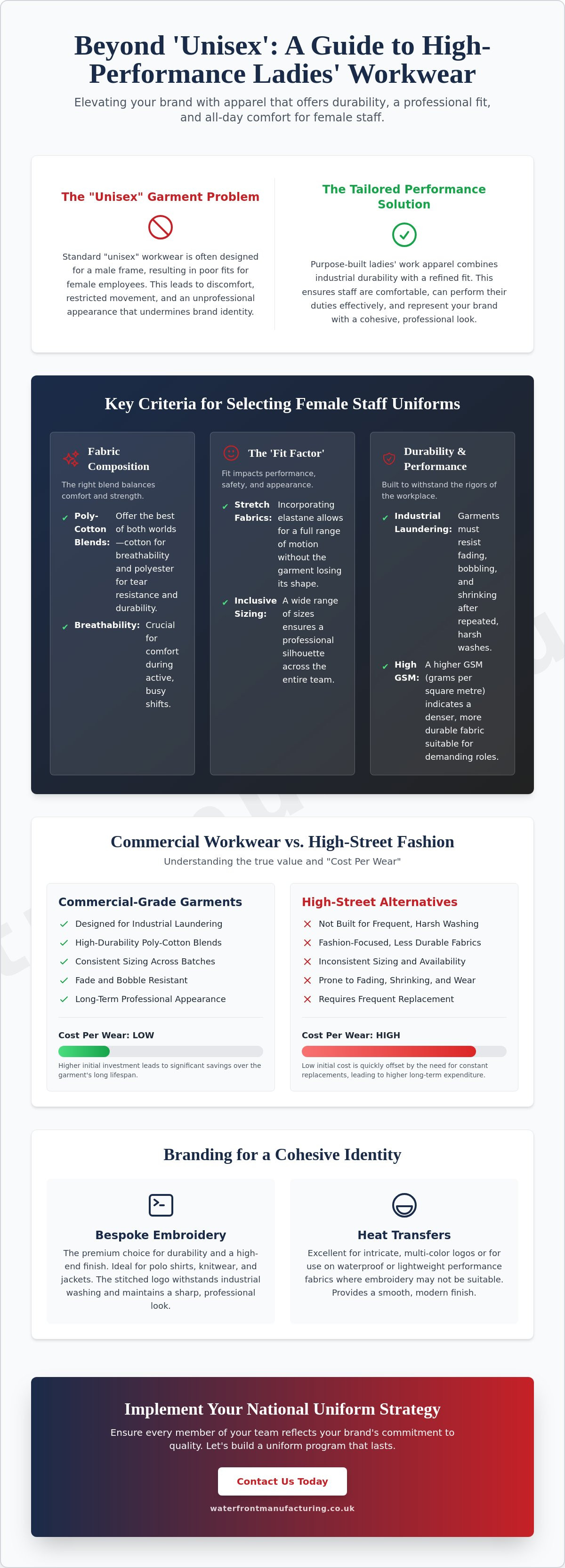
Procurement managers often face the temptation of low entry prices found in high-street retail. However, evaluating ladies work apparel through the "Cost Per Wear" metric reveals a different reality. A retail blouse might look acceptable on the shelf, but it is rarely engineered for the rigours of a professional environment. Most high-street garments begin to show significant signs of wear, such as thinning fabric or lost elasticity, after just 20 to 30 wash cycles. In contrast, commercial-grade workwear is manufactured to maintain its structural integrity for 50 cycles or more, even when subjected to the high temperatures of industrial laundering.
Industrial laundry environments are unforgiving. The combination of heavy-duty detergents and mechanical agitation quickly exposes the weaknesses in fashion-focused construction. We see this most often in failing seams, pilling fabrics, and significant colour fade. When your team wears garments that look tired after only a few months, it reflects poorly on your brand's attention to detail. Choosing garments built for purpose ensures that your investment lasts longer and your staff remains presented to a high standard.
One of the greatest risks of sourcing from the high street is the lack of continuity. Retailers operate on seasonal cycles, meaning a specific style or shade of navy can disappear from the shelves mid-season. This creates a "mismatched team" look that is impossible to correct without replacing every uniform. Professional corporate uniform suppliers uk solve this by offering multi-year style guarantees. We understand that your workforce grows; you need to know that a new starter in twelve months will be able to wear the exact same long sleeve Oxford shirt or tailored trousers as the rest of the team. This consistency simplifies the re-ordering process and protects your corporate identity.
Safety and compliance are areas where retail fashion simply cannot compete. Many roles require workwear clothing that meets specific UK safety regulations. For example, high-visibility items must comply with EN ISO 20471 to be legally fit for purpose. While a fashion retailer might sell a bright jacket, it likely lacks the UKCA or CE marking required for genuine PPE. Under UK law, employers are required to provide suitable PPE free of charge where risks cannot be controlled. There is a vast difference between a "fashion" waterproof and our waterproof storm proof parkas, which are designed to keep staff dry and safe in extreme conditions. We maintain strict in-house quality control to ensure every piece of apparel meets the necessary technical standards for your industry.
A professional uniform only achieves its full potential when the branding is executed with the same precision as the garment's construction. For ladies work apparel, the choice between embroidery and print isn't merely aesthetic; it's a technical decision based on fabric weight, stretch, and the intended environment. We view garment decoration as a craft that requires a deep understanding of textile behaviour. Whether you're outfitting a front-of-house team or a clinical staff, the branding must remain sharp and intact for the entire lifespan of the clothing.
Embroidery remains the gold standard for workplace clothes women wear in corporate and healthcare settings. This method involves a detailed digitisation process where your logo is converted into a stitch file, mapping out every needle penetration to ensure clarity. The result is a tactile, three-dimensional finish that conveys a sense of heritage and permanent quality. It's particularly effective on robust fabrics where the thread can be anchored securely without causing the material to pucker.
For more active roles, we often recommend heat transfers or screen printing. These methods are better suited for performance polo shirts or 3-layer softshell jackets where embroidery might compromise the garment's waterproof membrane or cause irritation against the skin. Modern heat transfers are engineered to move with high-stretch fabrics, ensuring that logos don't peel or crack even after repeated industrial washes. We prioritise the durability of your brand's visual identity, ensuring that the "first day" look persists for months.
The garment type dictates the best branding approach. Embroidery is the preferred choice for office wearing clothes for women, such as our v-neck cotton knitwear and tailored jackets. The weight of these fabrics supports the stitch count of a complex logo. Conversely, for lightweight organic cotton t-shirts or contrast hoodies, a high-quality print provides a clean finish without adding unnecessary bulk or weight to the chest area. This technical alignment ensures the garment remains comfortable and drapes correctly on the female frame.
Successful branding requires a simplified approach to design. Complex gradients or tiny text can become lost in thread, so we often advise on simplifying logos for small-scale embroidery. Precision colour matching is equally vital. We use Pantone references to ensure your corporate colours are replicated accurately across different batches. Positioning also plays a role in impact; while the left chest is traditional, we also offer branding on the sleeve or the nape of the neck for a more modern, subtle look. If you're ready to see how your logo translates to professional garments, you can browse our full range of customisable workwear today.
Transitioning from selecting individual garments to managing a full-scale rollout requires a partner who understands the complexities of national logistics and brand consistency. Waterfront Manufacturing Limited provides an end-to-end service that manages every stage of the process, from initial garment selection to final in-house customisation. This comprehensive approach ensures that your brand's standards remain high across every location, whether you are ordering women's tailored trousers for a regional office or performance polos for a nationwide service team. By managing the entire supply chain, we eliminate the friction often found when dealing with multiple middlemen.
Maintaining the personal touch of a family-run business while serving large-scale corporate clients is a core value of our operation. We don't believe in the faceless service models common in global supply chains. Instead, Waterfront Manufacturing Limited offers a steady hand and a commitment to precision that stems from our heritage in British manufacturing. Our national delivery capabilities mean we can support UK-wide organisations with the same level of care and attention to detail that we give to our local partners. This balance of industrial authority and approachability ensures that your requirements are handled with due care.
The Waterfront Manufacturing Limited guarantee is built on three pillars: durability, precision, and personalised service. We stand behind the quality of our ladies work apparel because we oversee the technical details ourselves. When you partner with us, you aren't just buying clothes; you're securing a reliable supply of professional attire that is built to last. We take collective responsibility for the success of your uniform strategy, ensuring that every garment meets our rigorous internal standards before it reaches your staff.
Managing size runs for a diverse workforce is often the most stressful aspect of uniform procurement. We simplify this process through dedicated account management, helping you navigate staff fit-outs without the typical administrative burden. Our pricing structures are designed for volume, ensuring that high-quality garments remain a viable long-term investment for your business. We handle the complex logistics of bulk ordering, allowing you to maintain a professional-looking team without the stress of managing individual re-orders for new starters.
Our in-house Norfolk workshop is the heart of our operation. By keeping our manufacturing and decoration processes local, Waterfront Manufacturing Limited maintains complete oversight of quality and offers reliable turnaround times. This setup allows us to uphold high manufacturing standards and ethical sourcing practices across our entire range, from waterproof storm proof parkas to v-neck cotton knitwear. We believe that quality manufacturing takes time and expertise, and we apply that philosophy to every order. Ready to upgrade your team? Get a bespoke workwear quote today.
Selecting the right ladies work apparel is a strategic decision that balances technical performance with a professional aesthetic. We've explored how moving away from high-street fashion toward commercial-grade garments improves durability and reduces long-term costs. By focusing on precise fit and robust fabric compositions, you ensure your team feels comfortable and respected in their roles. A cohesive uniform, reinforced with high-quality embroidery or heat transfers, serves as a permanent visual anchor for your brand identity across the UK.
Since 1999, our family-run business has prioritized British craftsmanship and functional excellence. We manage the entire process through our in-house embroidery and printing workshop, ensuring that every garment meets our rigorous standards for precision. With our national delivery capabilities and competitive bulk pricing, we provide a steady hand for organizations looking to simplify their procurement. We're ready to help you build a uniform strategy that reflects the integrity of your own business.
Request a Bespoke Quote for Your Team's Ladies Work Apparel
A poly-cotton blend is generally the most durable choice for ladies work apparel in professional environments. This combination utilizes the natural breathability of cotton alongside the synthetic strength of polyester to create a resilient garment. It resists pilling and maintains its color far longer than 100% natural fibers when subjected to frequent industrial laundering or heavy daily use.
Ensuring a consistent fit across a diverse workforce requires selecting garments with a high elastane content and using a single, reliable supplier. Stretch fabrics accommodate different body shapes while maintaining a uniform silhouette across the team. We provide comprehensive size runs to ensure every staff member receives a garment that fits correctly without the need for custom alterations.
Most professional garments, including Oxford shirts, tailored jackets, and cotton knitwear, are ideal for bespoke embroidery. However, very lightweight fabrics or waterproof outerwear may be better suited for heat transfer branding to avoid damaging the material. We assess each garment type to ensure the decoration method doesn't compromise the fabric's integrity or the wearer's comfort.
Ladies' cut workwear is specifically engineered for the female frame, featuring narrower shoulders, shorter sleeve lengths, and tapered waistlines. Unisex garments are typically based on male sizing, which often results in a boxy, unprofessional fit for women. Choosing gender-specific cuts ensures a sharper appearance and provides better freedom of movement for your staff during active shifts.
We recommend providing between three and five sets of apparel per employee to account for a standard working week. This allocation allows for one set being worn, one in the wash, and one ready for the next day. If staff are responsible for their own laundry, a minimum of three sets is usually sufficient to maintain a professional appearance without excessive wear.
Current trends in 2026 focus on softer tailoring and the use of sustainable materials like organic cotton. Professionals are moving away from rigid suits in favor of versatile pieces like refined poplin blouses and comfortable softshell jackets. There is also a growing demand for "elevated basics" that prioritize high-quality textures and durability over fleeting fashion trends.
To preserve embroidered logos, always wash garments inside out at a maximum temperature of 40 degrees Celsius. Avoid using bleach or aggressive biological detergents that can break down the thread fibers over time. Air drying is preferable to tumble drying, as high heat can cause the embroidery to pucker or the surrounding fabric to shrink unevenly.
Purchasing in bulk is the most cost-effective strategy for an initial rollout and ensures complete color and style continuity across the workforce. For new starters, we recommend maintaining a small buffer stock of common sizes in your own facility. This approach prevents the mismatched look that occurs when high-street retail lines are discontinued or changed mid-season.